

The production workflow is where most AI projects succeed or fail, and it’s not an easy system to build. This is in part because it runs counter to how most traditional production processes have been structured for decades. Traditional production is largely sequential, requiring significant preparation and planning prior to a shoot to ensure the vision is realized. A brief becomes pre-production, pre-production leads to a shoot, the shoot leads to post, and post leads to delivery. The creative logic, booking, and alignment are front-loaded because photo or video content is captured in an instant, and the ability to manipulate an image after that point is largely refinement.
When our AI Studio began producing content for in-market use, it became clear that generative production works differently. AI’s generative nature makes the process iterative. It still begins with broad exploration and narrows through multiple rounds of generation, review, and refinement, but the ability to explore new concepts extends much farther in the timeline. Teams move between concept, execution, and versioning fluidly, and that fluidity is not a lack of discipline, it’s actually the method. With AI, creative concepts are built and layered, and there isn’t a final execution point like there is with traditional capture. In this case, the image evolves throughout the entire process, minimizing the need for early logistics and expanding creative potential because the image is almost infinitely malleable.
Because of the iterative nature of AI creation, it’s essential that the creative objective is clear before a workflow is designed. This is because content-type drives workflow structure. Campaign content tends to be highly iterative and creative-led. Social and Tier 2 content often calls for a more agile hybrid approach. E-comm content typically requires tightly structured systems with explicit rules for variation, validation, and throughput. Getting that definition right at the start has a compounding effect on everything downstream.
The New Stages of Production
Every generative project moves through the following stages, though rarely in strict sequence, and often with significant overlap.
These stages layer upon one another and move fluidly in both directions. A team may move back into generation after a round of post, or return to curation after a new generation pass. With a team that knows the process, this moves fast, and it enables parallel development at a scale that traditional production cannot approach. Once the core elements are established, content volumes scale rapidly.


Ideation & References
The creative brief, references, and ideation form the foundation of a project, drawing on visual and cultural references, brand guidelines and codes, and initial concepts.
The strength and specificity of the creative vision at this stage shapes everything that follows. Vague briefs produce vague outputs, and generative tools will produce poor outputs at scale if the target is unclear.
RESEARCH & PIPELINE DEVELOPMENT
R&D plays a significant role in AI production. With a growing number of tools and configurations to work with, selecting the right approach for each project requires both technical research and hands-on experience. Two image generation models can produce completely different outputs from the same prompt, and it’s important to know which one serves a given project.
We build R&D into the initial phase of every project to determine the best approach, and continue it throughout production to optimize results as the work develops.
ExpLoration & Initial Generation
Initial generation is where creative directors and AI artists begin exploring a range of directions a concept can take. This stage strikes a balance of staying “on-brief” while also showing a range of possibilities.
A major benefit of AI is that we can generate fully realized concepts and variations quickly, allowing the team to select a final direction early on. The goal is to pick a path quickly and move to the production stage.
Production
Production is when all the elements that go into the final work are developed. This stage often leverages a range of techniques including AI generation, CG, traditional production, and post. Creative tech teams determine which generations work, which can be combined, and which directions have genuine traction.
This stage is where taste and experience have an outsized impact on where the project goes. Traditional capabilities, particularly CG, VFX, retouching, and compositing are used to resolve what generative tools cannot. We usually recommend that clients allocate more time and budget for post as opposed to less. This is because AI is great at reaching a strong starting point quickly, but CG and traditional post are what turn raw output into market-ready content.
Refinement & Detail
Refinement and detail work comes into play as the work narrows toward a final direction.
During this stage, production experience and a critical eye become increasingly important. Elements like light, shadow, perspective, surface plane, texture, product and object accuracy, grain, and geometry all require careful evaluation. Small errors at this stage compound in-market, and catching them takes a trained eye honed by real production experience.
Delivery
Delivery happens in parallel with volume development.
Once the core articulation of a concept is set, a new set of models and products are able to scale the content for different teams, formats, and channels.
The End-to-End Workflow
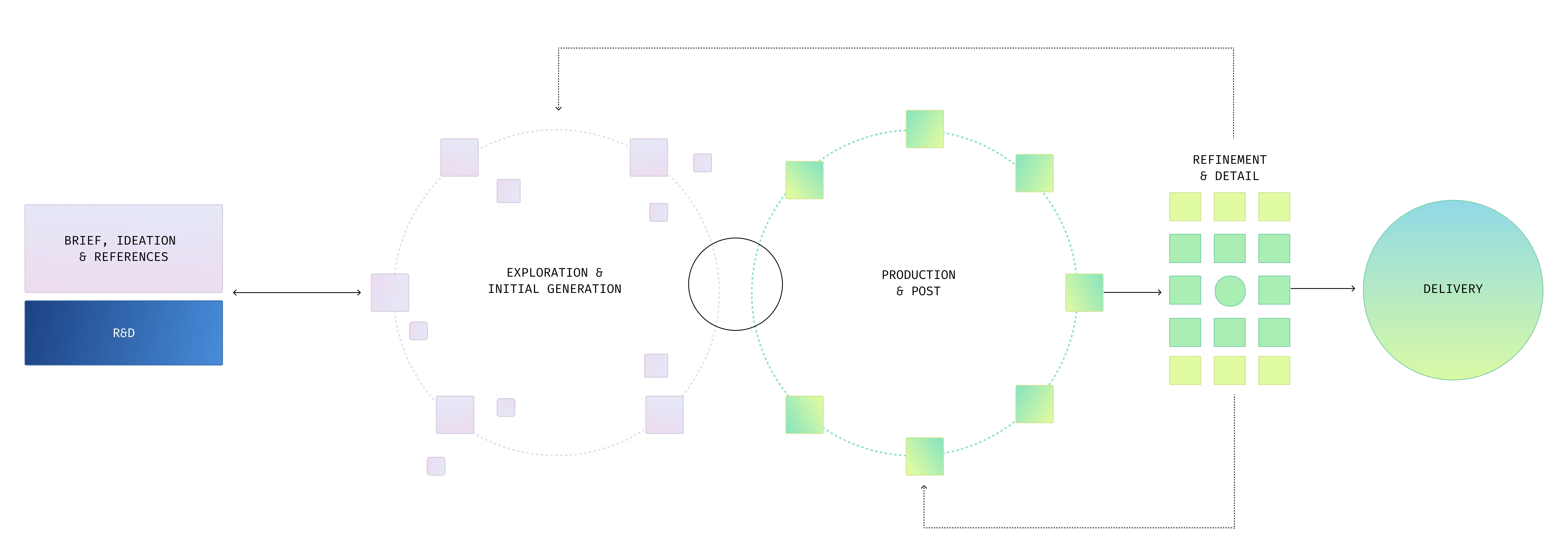
THE RISE OF POST
AI is excellent at exploring new concepts and realizing strong starting points, but human craft is what turns raw output into brand-ready assets. The most efficient AI workflows are hybrid, and the role of traditional post production only increases with AI. The failure points of generative tools tend to live exactly where brand standards are highest: color accuracy, anatomy, physics, and material precision. In hybrid workflows, these are addressed throughout the production lifecycle rather than patched at the end. Retouching corrects product accuracy, CG resolves geometry and materials, compositing integrates elements convincingly, and upresing and finishing bring the work to the standard global campaigns require.
The most efficient and highest-quality results come when generative and traditional techniques are applied deliberately and in the right sequence. The relationship is dynamic, and post production is a core production discipline, not a final step.
Managing Quality
Quality control needs to be embedded throughout the workflow rather than applied as a final checkpoint. That means during generation, compositing and refinement, finishing, and proofing, with dedicated attention by trained eyes at each stage.
This is especially important for print and large-format applications. AI-generated work that passes review at digital size can reveal artifacts, resolution problems, edge issues, hallucinations, and material inconsistencies when it is enlarged. The ability to proof and QC at scale, including for large-format output, is a production capability that tends to be underestimated until something fails on the public stage.
AI undoubtedly makes it easier to produce content. It also makes it harder to guarantee that content is correct unless quality control is built into the process from the beginning.
Now Is The Time To Begin
Getting AI creative production right is not primarily a technology question. It is a workflow question, and within that, a tool selection and expertise question. The teams that move effectively are the ones that educate themselves on the landscape, define how they want to get started, and identify where they can partner with experts who have genuine AI fluency to help them succeed.
Developing production workflows that map to the technology’s strengths and weaknesses is a critical building block to being able to take advantage of advancements as the industry continues to accelerate.